
Harm reduction researcher Jai Whelan wants to know more about ketamine and methamphetamine. We sat down with Jai to talk about these research projects and how they could help New Zealanders who use drugs.
Kia ora Jai! What are these two studies called, and what are they looking at?
 So, the first study is called the Aotearoa Ketamine Survey. Its main purpose is to fill in the gaps about ketamine in New Zealand – we’re pretty confident that use has gone up, although because some surveys lump ketamine in with other psychedelics, we’re not sure by how much. Regardless, we know people are using it, but we don’t know a lot about how or why. Head to the webpage to take the survey.
We also want to find out what effects people experience when they’re using ketamine - positive effects could be relief from mental health symptoms, but negative effects could be memory issues or bladder problems. We’re also interested in how people stay safer – what harm reduction methods they use. Check out some tips on The Level's ketamine drug info page.
The second study is called the Aotearoa Methamphetamine Perspective Study (aka AMPS - I wanted a nice acronym for it!).
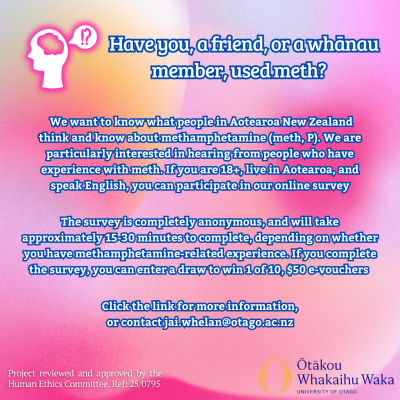
AMPS is looking at people’s perspectives of methamphetamine in New Zealand. It asks people their attitudes towards methamphetamine and people who use it and asks questions to get a feel for how much people know about it. We’re also interested in what barriers people think there are to getting help or support. If you’re someone who has used methamphetamine before, or someone who works with people who use drugs in your mahi, we’re also interested in finding out a bit more from you, such as experiences of stigma, or how you feel about supporting those with methamphetamine issues. If you fit any of the above descriptions, head to the AMPS survey page to find out more.
Love the acronym. What are you hoping to achieve with these two studies?
The ketamine study could have implications for harm reduction communication and services for people who use ketamine. But we need to get a bit of a lay of the land first, then see what we can do with it.
The AMPS methamphetamine study is more designed to inform our next steps across research, substance treatment, harm reduction, policy, and more general health and stigma reduction campaigns. We’re also interested in what wellbeing factors people think are most important in methamphetamine treatment. Understanding how the perception of what’s important might differ across groups can give us some hints that are useful for assisting treatment providers and kaimahi in the space.
As part of AMPS, we’re also asking people how they feel about different kinds of treatment and harm reduction approaches, from kaupapa Māori and residential treatment to things like safer smoking kits and stimulant replacement therapy. That will be useful to know because there’s not a lot of people trying new things, even though other countries are starting to do these things. If there’s good support for some novel approaches, it could be worth it to begin developing these.
Is there much other research going on about this at the moment?
Although New Zealand tends to make a lot of noise about methamphetamine as an issue, there’s not that many people working on it in the research space. There’s the Tū Whakaruruhau study (Waipapa Taumata Rau) looking at methamphetamine treatment evaluation, the Tū Wairua mahi at Rangiwaho marae, and a Kaupapa Māori contingency management study (Te Kunenga ki Pūrehuroa). I’m not aware of anyone else focusing on methamphetamine.
How many people are you hoping will complete these surveys? Who are you wanting to hear from?
For both, you need to be over 18, living in New Zealand and fluent in English.
For the ketamine study, we’re hoping for 800+ survey responses from anyone who has used ketamine in Aotearoa in the past five years. Head to the Aotearoa Ketamine Survey page for more info.
For AMPS, we’re aiming to recruit a minimum of 1000 participants, with a decent proportion of people who have used methamphetamine, and another group of people who support those who use methamphetamine within their mahi. Our AMPS study page has more info.
Participants in both studies can go in the draw to win a $50 gift voucher.
Is there anything else you’re interested in researching at the moment?
I've been really interested recently in how to navigate or promote harm reduction in Te Ao Māori. There’s quite a lot of tension there (which I think is largely colonisation’s fault). But there's a lot of questions in this space that I think need further exploration; should Māori be drug free – and what does drug-free mean in this context? What is the impact of drug use on mana (if any)? How do drugs and wairuatanga interact in positive and negative ways? There’s a lot of room for discussion!
You’ve been researching drug use and harm reduction in Aotearoa for a few years now. What are some of the gold nugget bits of info from your past research?
From our study about MDMA use in New Zealand, we now have more of an understanding of the average number of drinks people are having alongside MDMA. It’s been good having that as a reflection point for people.
Another one was that a fifth of people didn’t know how much a usual dose of MDMA was (around 100mg, for the record). It’s critical info and it’s changed how we have conversations. People would come in with a gram of MDMA and say they were splitting it with a friend, and we’d then ask, "do you know that would be four to five times the amount that we’d recommend?"
From a study we did about nitrous oxide, less than a third of people knew that it can deplete B12 levels in your body, and that can then cause nerve damage.
A good chunk of people also thought that even a small amount of nitrous oxide is toxic to brain cells. This is interesting given that it is an essential medicine that is used regularly in emergency departments, dentistry, and given during labour!
What are your top three harm reduction tips?
I think a lot of my top tips aren’t related to specific drugs but are just about not being a dick.
Number one is: be warm and open.
Two, you can always take more, but you can’t take less.
Three, you don’t need to rush to have a good time.
And an extra one: set and setting apply to all drugs, not just psychedelics!
Head to Aotearoa Ketamine Survey page for more info and to take the survey.
Join the Aotearoa Methamphetamine Perspectives Survey or get more info on the webpage.
Related stories
Stay up to date with The Level
Sign up to our newsletter
Recent stories
Running for recovery: meet the Speed Freaks
Meet the Speed Freaks, a nationwide running for recovery group.
Online alcohol & drug support for people with ADHD
Join our supportive online space for people with ADHD to talk about change and recovery. You don’t need to be formally diagnosed to join.